

Views: 0 Author: Site Editor Publish Time: 2026-11-13 Origin: Site


Diaphragm Valves are widely used in sanitary and industrial processing systems where reliable shutoff, contamination prevention, and fluid compatibility are essential. Different valve designs, body materials, and operating methods make them suitable for different production environments. This guide explains diaphragm valve types, material differences, and applications across pharmaceutical, food, chemical, water treatment, and biotechnology industries to help engineers and buyers select the right valve for their systems.
How Do Diaphragm Valves Work?
Main Types of Diaphragm Valves
Diaphragm Valve Materials and Their Differences
Sanitary Diaphragm Valves vs. Industrial Diaphragm Valves
Applications of Diaphragm Valves in Different Industries
How to Choose the Right Diaphragm Valve
Common Diaphragm Valve Problems and Maintenance
Conclusion
FAQ
Core Keywords: Diaphragm Valves, Sanitary Valve, Pneumatic Diaphragm Valve, Food and Beverage Processing, Stainless Steel Diaphragm Valve, Water Treatment Systems, Plastic Diaphragm Valve, Chemical Processing, Aluminium Alloy Diaphragm Valve, Biotechnology Industry, Pharmaceutical Industry.
A diaphragm valve is a flow-control device that uses a flexible diaphragm to regulate or completely shut off fluid flow. Unlike conventional valves that use a rotating ball, disc, or gate, a diaphragm valve controls the medium through the movement of a flexible sealing component.
The diaphragm is positioned between the process fluid and the upper operating assembly. When the valve closes, the diaphragm moves toward the valve seat or weir and blocks the flow passage. When the valve opens, it lifts away from the sealing surface and allows fluid to pass through.
The key design advantage is the separation between the process medium and the stem or actuator mechanism. This arrangement can reduce potential external leakage paths and limit contact between the process fluid and certain mechanical components.
A typical diaphragm valve contains several important components:
Valve Body: Forms the internal flow passage and supports the diaphragm.
Diaphragm: A flexible sealing element that opens, closes, or throttles the flow path.
Compressor: Transfers force from the stem or actuator to the diaphragm.
Bonnet: Protects the upper operating mechanism.
Stem: Transfers movement from the handwheel or actuator.
Actuator or Handwheel: Provides the force needed to operate the valve.
During opening, the stem or actuator moves the compressor upward, allowing the diaphragm to move away from the sealing area. The available flow area increases as the diaphragm lifts.
During closing, the operating mechanism pushes the diaphragm downward against the sealing surface. The diaphragm forms the barrier that stops the process medium.
The design can support on/off isolation and, in suitable configurations, throttling. However, diaphragm valves should not automatically be treated as precision control valves. The actual control performance depends on valve geometry, sizing, actuator characteristics, and process conditions.
Diaphragm valves are available in different configurations according to internal structure, operating method, and pipeline requirements. The right type depends on the fluid, required flow path, operating frequency, and automation strategy.
A weir-type diaphragm valve has a raised sealing area inside the valve body. When the valve closes, the diaphragm presses against this raised section to stop fluid flow.
One advantage is the relatively short diaphragm travel distance, which can reduce the amount of deformation required during each operating cycle.
Weir-type designs are commonly considered for:
Pharmaceutical production systems.
Food and beverage processing.
Chemical dosing applications.
Clean-fluid distribution.
Hygienic pipeline systems.
The raised weir provides a defined sealing area, making this configuration suitable for many applications requiring reliable shutoff.
A straight-through diaphragm valve has a relatively unobstructed flow passage and does not rely on a raised weir as its main sealing geometry.
The more open passage can be useful for certain viscous fluids, suspended solids, and slurry services.
Typical applications include:
Wastewater treatment.
Industrial slurry transportation.
Chemical processing.
Filtration systems.
Industrial fluid distribution.
The diaphragm may need to travel farther than in a weir-type design. Therefore, diaphragm movement, wear, and operating frequency should be evaluated when selecting a straight-through valve for demanding service.
A pneumatic diaphragm valve uses compressed air to operate the diaphragm through an actuator. Compared with manual operation, pneumatic actuation supports remote control, repeatable operation, and integration with automated production lines.
Common configurations include:
Normally Closed (NC): Designed to move to the closed position when the operating air supply is lost, subject to the actuator's spring-return arrangement.
Normally Open (NO): Designed to move to the open position when the operating air supply is lost, subject to the actuator's spring-return arrangement.
Double-Acting: Uses air pressure for both opening and closing movements and does not inherently provide the same spring-return fail position as a single-acting actuator.
The required configuration depends on the process safety strategy, control logic, and desired response to loss of air.
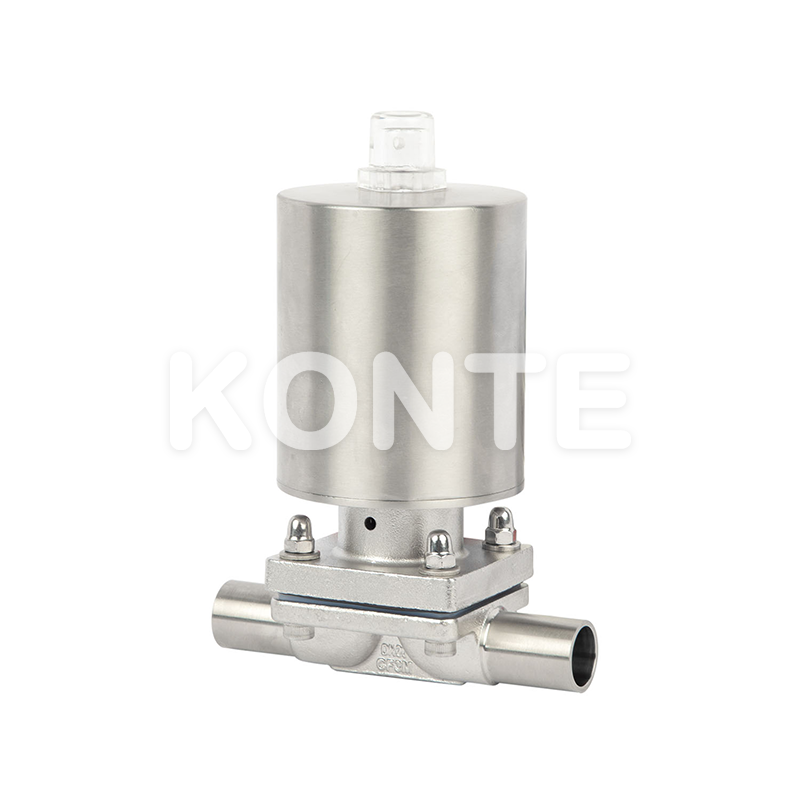
Product image placement: Insert the main product image from KONTE's Stainless Steel Pneumatic Tri-clamped Diaphragm Valve detail page. Use the product gallery image rather than an externally hosted image URL.
In automated systems, pneumatic diaphragm valves can help reduce manual intervention and improve operating consistency. For projects requiring different automation configurations, buyers can also explore KONTE's Pneumatic Actuators to understand available actuation solutions.
Manual diaphragm valves use a handwheel or other manual operating mechanism to move the diaphragm. They are suitable for systems where valves are operated occasionally or where automatic control is not necessary.
Common applications include:
Maintenance points.
Sampling lines.
Small fluid distribution systems.
Utility pipelines.
Infrequently operated process lines.
Manual operation keeps the control arrangement simple, without requiring compressed air or electrical signals.
For frequently cycled production lines, remote installations, or PLC-controlled processes, a pneumatic configuration may be more appropriate.
A three-way diaphragm valve has multiple ports that allow it to divert or combine process flows. The exact flow path depends on the port arrangement and internal body design.
Three-way configurations can simplify pipeline layouts where a process needs to route fluid between vessels, branches, or production stages.
They may be considered in:
Pharmaceutical fluid distribution.
Food processing systems.
Biotechnology production.
Chemical mixing systems.
Automated fluid-transfer equipment.
Tank-bottom diaphragm valves are designed for installation at the bottom outlet of a vessel or tank. They are used where controlled discharge and a suitable vessel connection are required.
The valve's geometry, drainability, and connection arrangement should be checked against the vessel design.
| Valve Type | Main Characteristics | Typical Applications | Main Selection Consideration |
|---|---|---|---|
| Weir-Type | Raised sealing area and relatively short diaphragm travel | Pharmaceutical, food, and dosing systems | Shutoff, diaphragm life, and cleanability |
| Straight-Through | Relatively open flow passage | Slurry, wastewater, and viscous fluids | Solids content and flow resistance |
| Pneumatic | Compressed-air actuation | Automated production lines | Actuator type and fail position |
| Manual | Handwheel operation | Simple or infrequently operated lines | Operating frequency |
| Three-Way | Multiple flow connections | Flow diversion and confluence | Port arrangement and flow direction |
| Tank-Bottom | Vessel-bottom installation | Tank discharge and process vessels | Drainage and vessel connection |
These configurations are not interchangeable. A valve intended for clean pharmaceutical fluids may not be the best choice for abrasive slurry or a vessel-bottom discharge point.
Material selection affects corrosion resistance, mechanical strength, sealing performance, cleanability, and service life. When reviewing a diaphragm valve, buyers should identify the material of each major component rather than relying only on the product name.
Stainless steel diaphragm valves are widely considered for sanitary and industrial processing because of their mechanical strength and corrosion resistance in many service environments.
Common casting grades used in valve construction include CF8 and CF8M. Their suitability depends on the exact chemical composition, operating temperature, and process medium.
Stainless steel designs may be selected for:
Pharmaceutical and biotechnology fluid systems.
Food and beverage processing.
Purified water distribution.
Chemical processing with compatible media.
Industrial fluid handling.
Stainless steel alone does not guarantee sanitary suitability. Internal surface finish, weld quality, drainage, dead-leg design, diaphragm material, and cleaning compatibility also matter.
Plastic diaphragm valves may be selected where a specified polymer body offers suitable resistance to the process medium. Depending on the valve design and manufacturer, industrial thermoplastics can include PVC, PP, or PVDF.
The polymer grade must be matched to the chemical composition, concentration, temperature, and pressure. Different plastics have different mechanical and chemical-resistance limits, so the term "plastic valve" is not a sufficient material specification.
Potential advantages of an appropriate plastic-bodied design include:
Lower component weight than many metal alternatives.
Resistance to selected acids, alkalis, and corrosive fluids.
Reduced risk of metallic contamination in suitable applications.
Suitability for selected water-treatment and chemical-dosing duties.
Product image placement: Insert the main product image from KONTE's Plastic Manual Tri-clamped Diaphragm Valve detail page. Select the image directly from the product gallery.
Before ordering a plastic diaphragm valve, confirm the actual body polymer and every wetted component. Do not assume that a model's product title alone identifies all material grades.
Aluminium alloy is valued for its relatively low weight, machinability, and strength-to-weight characteristics. In a pneumatic diaphragm valve assembly, aluminium alloy may be used in the actuator cylinder or housing.
It is essential to distinguish the valve body from the actuator cylinder. The valve body and diaphragm are part of the wetted or pressure-containing assembly, while the actuator cylinder is normally part of the operating mechanism.
If a valve is described as an aluminium alloy diaphragm valve, buyers should check the material schedule and product drawing to determine exactly which components use aluminium alloy.
The wetted body material must be compatible with the process medium. Aluminium alloy should not be assumed suitable for every corrosive chemical, cleaning solution, or high-purity process.
The diaphragm is one of the most important components because it flexes during operation while maintaining the sealing barrier.
Common diaphragm material options include:
PTFE: Offers broad chemical resistance and is used in many demanding chemical and hygienic applications.
RPTFE: Reinforced PTFE designed to improve selected mechanical properties.
PPL: An option listed for certain valve configurations; the exact compound and service limits should be confirmed.
Elastomers such as EPDM: Used in designs where flexibility and application-specific compatibility are required.
A diaphragm material should be selected according to chemical compatibility, operating temperature, pressure, cleaning conditions, and cycle frequency.
A material suitable for one fluid may not be suitable for another, even when both are handled at similar temperatures.
| Component | Possible Material Options | Main Selection Factors |
|---|---|---|
| Valve body | CF8, CF8M, specified engineering plastics, or other model-specific materials | Corrosion, pressure, temperature, and mechanical strength |
| Diaphragm | PTFE, RPTFE, PPL, and suitable elastomers | Chemical compatibility, flexibility, and cycle life |
| Actuator cylinder | Polyamide, aluminium alloy, or other specified materials | Air pressure, installation environment, and actuator design |
| Fasteners and auxiliary parts | Stainless steel or specified materials | Corrosion exposure and assembly requirements |
Always evaluate the wetted materials as a complete set. The valve body, diaphragm, liner, seals, and connection gaskets may all contact the process medium.
Sanitary and industrial diaphragm valves share the same basic operating principle, but their design priorities are different.
Sanitary valves prioritize hygiene, cleanability, and contamination control, while industrial diaphragm valves are often selected around chemical compatibility, pressure, temperature, flow characteristics, and maintenance requirements.
| Comparison | Sanitary Diaphragm Valves | Industrial Diaphragm Valves |
|---|---|---|
| Main priority | Hygiene and contamination prevention | Process reliability and media compatibility |
| Typical body material | Stainless steel or other approved wetted materials | Stainless steel, plastics, lined materials, or other specified alloys |
| Internal design | Cleanable and drainable product-contact surfaces | Designed around process and maintenance requirements |
| Connections | Tri-clamp, welded, and other hygienic connections | Flanged and other industrial connections |
| Cleaning | May require CIP/SIP compatibility | Depends on process requirements |
| Typical industries | Pharmaceutical, food, beverage, and biotechnology | Chemical processing, water treatment, and general industry |
Sanitary diaphragm valves are used in processes where product-contact surfaces must be cleaned effectively and contamination risks must be controlled.
Important design factors include:
Smooth product-contact surfaces to support cleaning.
Appropriate material grades for the product and cleaning chemicals.
Suitable connection types, such as tri-clamp or welded connections.
Drainability and reduced product-retention areas.
Compatibility with the facility's validated cleaning or sterilization procedures.
For other hygienic fluid-control requirements, buyers can explore KONTE's wider Sanitary Valves range.
Industrial diaphragm valves may handle water, chemicals, oils, gases, and other process media. Selection therefore depends on the actual operating conditions.
Chemical compatibility and pressure-temperature limits are often the first checks. Engineers should also consider solids content, flow velocity, pressure drop, connection standards, and maintenance access.
A sanitary valve should not be selected solely because it is made from stainless steel, and an industrial valve should not be used in a hygienic process without verifying the relevant design and documentation requirements.
For systems involving different valve types, KONTE also offers a broader Industrial Valves range.
Diaphragm valves are used in several industries because their design can provide reliable isolation and a barrier between the process medium and the operating mechanism.
The exact valve configuration and materials must still be matched to each industry's process requirements.
Pharmaceutical production involves sensitive fluids and strict contamination-control requirements. Diaphragm valves may be used in purified water systems, water-for-injection distribution, buffer preparation, process-fluid transfer, and selected CIP/SIP circuits.
Important selection factors include:
Wetted-material traceability.
Surface finish and cleanability.
Drainability and dead-leg management.
Diaphragm compatibility with process and cleaning media.
Suitability for the facility's cleaning and sterilization procedures.
A valve's use in a pharmaceutical plant does not automatically mean that it is suitable for every sterile or aseptic duty. The complete design and documentation must meet the project's requirements.
Food and beverage facilities handle dairy products, juices, brewing ingredients, syrups, liquid foods, and cleaning fluids.
Sanitary diaphragm valves may be considered where hygienic fluid isolation, product-contact material compatibility, and convenient cleaning are important.
Typical applications include:
Dairy processing lines.
Beverage production.
Brewing systems.
Liquid ingredient transfer.
Syrup and sauce processing.
Cleaning and utility circuits.
Connection design is also important. Tri-clamp connections can support convenient disassembly, while welded connections may be preferred in pipeline sections designed to minimize removable joints.
Water treatment facilities use valves in filtration, chemical dosing, purification, and wastewater handling systems.
Diaphragm valves may be considered for chemical injection, selected water distribution points, filtration skids, and compatible wastewater duties.
When selecting a valve for water treatment, engineers should consider:
Whether the fluid is clean water, wastewater, or a chemical solution.
Chemical concentration and pH.
Suspended solids and potential abrasion.
Operating pressure and temperature.
Body and diaphragm compatibility.
Required manual or automatic operation.
A valve suitable for clean water may not be suitable for concentrated dosing chemicals or abrasive wastewater. The process medium must be identified precisely.
Chemical processing plants may handle acids, alkalis, solvents, and other aggressive media. The valve body and diaphragm must be compatible with the actual fluid composition and operating conditions.
Important considerations include:
Chemical identity and concentration.
Operating temperature.
Pressure and pressure fluctuations.
Exposure time and cleaning conditions.
Corrosion resistance of all wetted components.
Diaphragm flexibility and service life.
Material compatibility should be verified for the complete valve assembly, not just the body material. In some applications, a lined valve or a different valve design may be more appropriate.
Biotechnology processes include fermentation, cell culture, bioreactor operation, buffer preparation, and sterile fluid transfer.
Diaphragm valves can be used where controlled flow, product isolation, and cleanable process connections are required.
Selection should consider:
Process-fluid compatibility.
Sterile boundary requirements.
Cleaning and sterilization cycles.
Valve drainability.
Diaphragm material and replacement intervals.
Automation and process-control requirements.
In biotechnology systems, the valve must be evaluated as part of the complete process design, including piping, vessels, instruments, and cleaning procedures.
| Industry | Typical Application Areas | Key Valve Requirements |
|---|---|---|
| Pharmaceutical | Purified water, process fluids, CIP/SIP circuits | Hygiene, traceability, cleanability |
| Food and beverage | Dairy, juice, brewing, liquid ingredients | Product-contact compatibility and easy cleaning |
| Water treatment | Chemical dosing, filtration, wastewater | Corrosion resistance and flow-path suitability |
| Chemical processing | Acid, alkali, and process-fluid handling | Chemical compatibility and pressure-temperature limits |
| Biotechnology | Fermentation, bioreactors, sterile transfer | Contamination control and process compatibility |
Selecting a diaphragm valve requires a systematic review of the process conditions. Choosing only by nominal diameter or product name is not enough to ensure reliable operation.
Start by identifying the exact fluid or gas that will pass through the valve.
Record the chemical composition, concentration, viscosity, solids content, and corrosiveness. For mixtures or cleaning solutions, obtain the relevant concentration and temperature data.
Accurate medium identification is the foundation of material selection.
Check the normal operating pressure, maximum pressure, pressure differential, and temperature range.
Also consider temporary conditions such as startup, shutdown, cleaning, sterilization, and pressure surges.
The selected valve must remain within the manufacturer's specified operating limits under the most demanding expected conditions.
Evaluate the valve body and diaphragm separately.
For example, stainless steel may be suitable for many process environments, but the diaphragm still needs to resist the process fluid and cleaning chemicals.
Do not assume that a compatible body material guarantees a compatible diaphragm.
Select manual or pneumatic operation based on the process-control requirements.
Manual valves can suit occasional operation and simple isolation points.
Pneumatic valves can suit frequent cycling and automated production lines.
Single-acting actuators may provide a defined spring-return position.
Double-acting actuators use air pressure for both operating directions.
The required fail position should be determined by the process safety assessment, not selected solely for convenience.
Confirm the required connection type, size, pressure class, and applicable dimensional standard.
Common options include:
Tri-clamp connections.
Welded connections.
Flanged connections.
The connection must match the pipeline and the hygiene or maintenance requirements of the facility.
Before purchasing, request and check:
Product datasheet.
Material specifications.
Dimensional drawings.
Pressure and temperature ratings.
Diaphragm compatibility information.
Connection details.
Relevant inspection and testing records.
Applicable certificates and compliance documentation.
KONTE describes its manufacturing inspection and testing capabilities through its Quality Control process. Buyers can review the relevant information when evaluating supplier manufacturing and inspection capabilities.
Although diaphragm valves have a relatively straightforward design, their performance depends on proper installation, suitable materials, and regular inspection.
The diaphragm is a flexible wear component, so its condition should be monitored according to operating frequency and service conditions.
| Potential Problem | Possible Cause | Recommended Action |
|---|---|---|
| Internal leakage | Diaphragm wear, damage, or sealing-surface contamination | Inspect the diaphragm and sealing area |
| External leakage | Damaged diaphragm or incorrect assembly | Check the diaphragm and bonnet assembly |
| Difficult operation | Actuator, stem, or operating mechanism issue | Inspect the actuator and moving components |
| Reduced flow | Incorrect valve position or internal obstruction | Check the flow passage and operating position |
| Premature diaphragm failure | Chemical incompatibility or excessive deformation | Reassess materials and operating conditions |
| Unstable pneumatic operation | Inadequate air supply or actuator problems | Check air pressure, air quality, and actuator function |
A practical maintenance program should include:
Regular diaphragm inspection: Look for cracks, deformation, swelling, hardening, or other signs of deterioration.
Material compatibility review: Reassess the diaphragm if the process fluid or cleaning chemical changes.
Actuator inspection: Check pneumatic connections, air supply, and operating response.
Sealing-surface inspection: Remove contamination and inspect for damage during scheduled maintenance.
Correct replacement procedures: Use the specified diaphragm material and follow the manufacturer's assembly instructions.
Avoid excessive closing force or incorrect actuator adjustment. These conditions can place unnecessary stress on the diaphragm and shorten its service life.
For additional information about manufacturing support and technical assistance, buyers can review KONTE's Service capabilities.
Diaphragm valves provide versatile flow-control solutions for sanitary and industrial processing systems. However, different valve configurations and materials are designed for different operating conditions.
Stainless steel diaphragm valves are widely considered for hygienic and demanding industrial applications, while plastic diaphragm valves may suit selected corrosive-fluid services. Pneumatic configurations support automated operation, and aluminium alloy may be used in specific valve or actuator components.
The most effective selection process evaluates valve structure, body material, diaphragm compatibility, operating pressure, temperature, connection type, and application requirements together.
KONTE provides diaphragm valve products for a range of sanitary and industrial fluid-control applications. Explore the available product range and contact the KONTE team to discuss your process conditions, material requirements, and valve configuration.
The main advantage is that the diaphragm separates the process medium from the upper operating mechanism. This can reduce potential external leakage paths and help control contamination risks in suitable applications.
Sanitary diaphragm valves prioritize hygiene, cleanability, and product-contact material requirements. Industrial diaphragm valves are generally selected around process conditions such as chemical compatibility, pressure, temperature, and flow characteristics.
The correct choice depends on the actual process requirements, not simply whether the valve body is stainless steel.
Yes, pneumatic diaphragm valves can be used in pharmaceutical systems when their wetted materials, hygienic design, cleaning compatibility, and technical documentation meet the application's requirements.
The actuator configuration should also match the required control and fail-safe strategy.
Some plastic diaphragm valves can handle selected corrosive chemicals, provided the polymer body, diaphragm, seals, and other wetted parts are compatible with the medium.
Chemical concentration and temperature must be checked before selection. Not all plastic materials are resistant to the same chemicals.
Buyers should confirm exactly which components use aluminium alloy, including whether it is the valve body or actuator cylinder.
They should also verify the wetted-material specifications, pressure rating, temperature limits, and chemical compatibility.
There is no universal replacement interval. Diaphragm service life depends on material, operating temperature, pressure, chemical exposure, and operating-cycle frequency.
Follow the manufacturer's maintenance recommendations and replace the diaphragm when inspection identifies wear or damage.


