

Views: 0 Author: Site Editor Publish Time: 2026-08-02 Origin: Site


A PVC Butterfly Electric Actuated Valve combines a PVC butterfly valve with an electric actuator for automatic on/off and flow control. Its corrosion resistance, lightweight construction, and easy maintenance make it suitable for ambient-temperature, low-to-medium-pressure water treatment systems. This article covers its working principle, benefits, applications, comparison with metal valves, and key selection factors to help you choose the right valve.
Table of Contents
What Is a PVC Butterfly Electric Valve?
How Does a PVC Electric Butterfly Valve Work?
Why Use PVC Valves for Water Treatment?
PVC Electric Butterfly Valve vs Metal Electric Butterfly Valve
Main Applications of PVC Butterfly Electric Valves
How to Choose the Right PVC Butterfly Electric Valve
FAQ
Core Keyword: PVC Electric Butterfly Valve,PVC Butterfly Valve,Electric Actuated Butterfly Valve,On/Off PVC Electric Butterfly Valve,Water Treatment Butterfly Valve
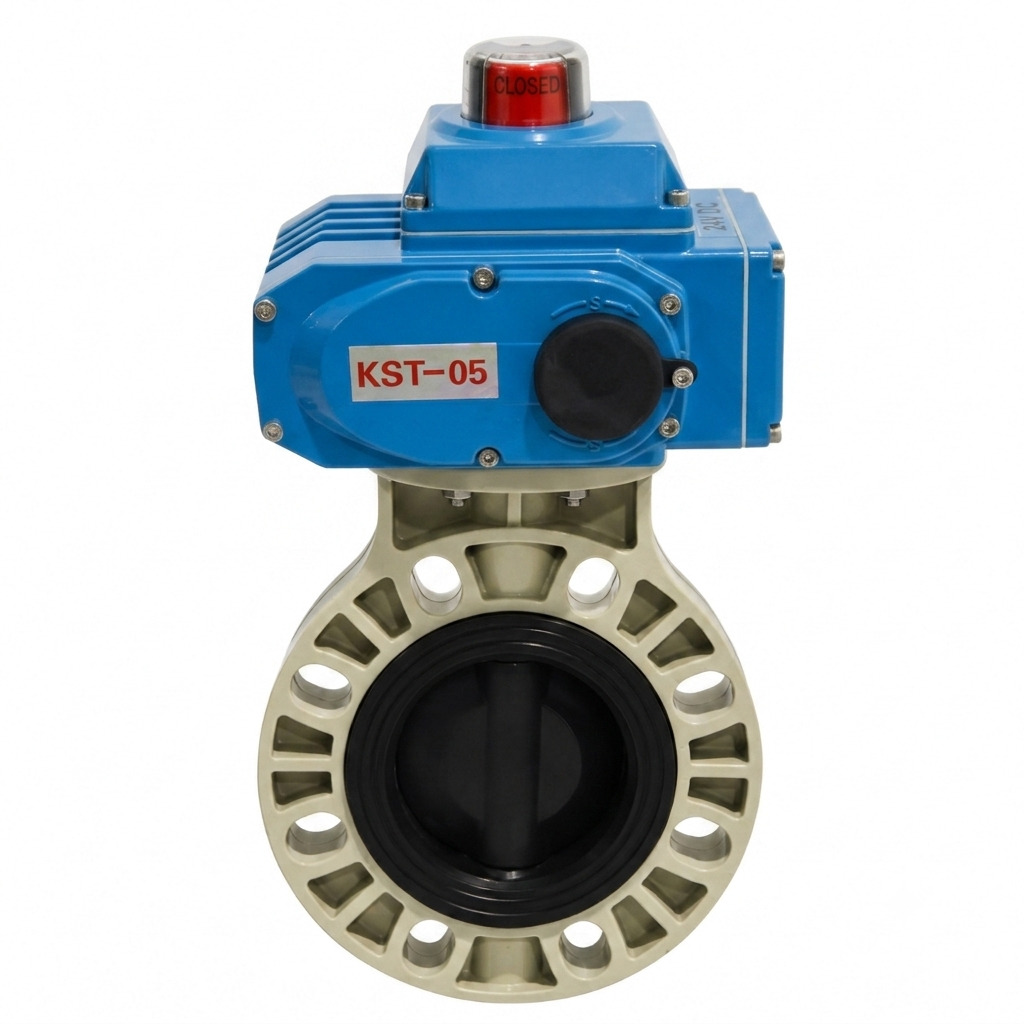
A PVC butterfly electric valve is an automated flow-control valve consisting of a PVC butterfly valve and an electric actuator.
The valve body contains a rotating disc mounted on a central shaft. Turning this disc controls the flow through the pipeline:
A disc parallel to the flow allows fluid to pass.
A disc perpendicular to the flow shuts off the pipeline.
An intermediate disc position can regulate the flow within an appropriate operating range.
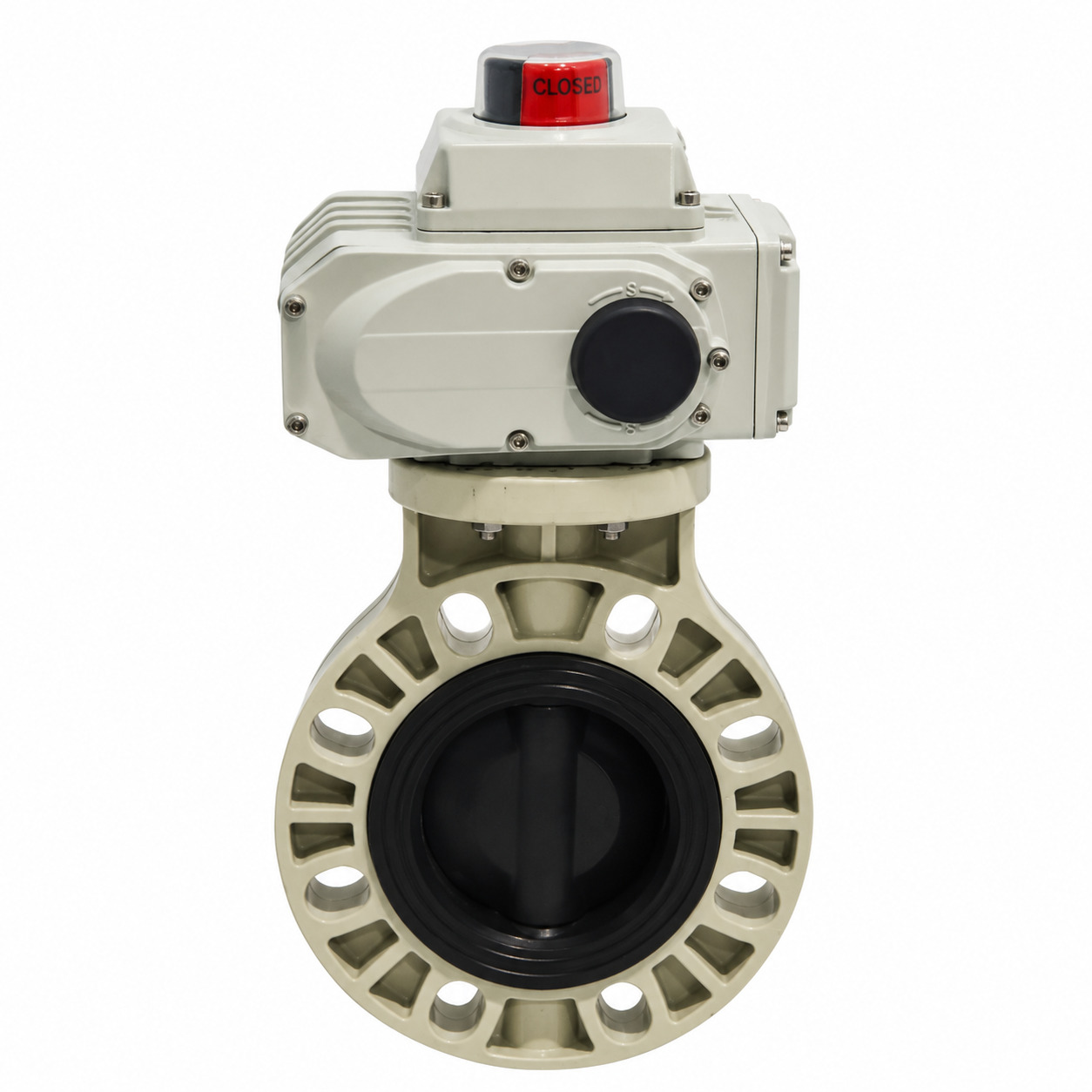
The electric actuator uses a motor and gearbox to rotate the valve shaft. Depending on the actuator configuration, the valve can provide simple on/off isolation or modulating flow control.
Typical components include:
PVC or CPVC valve body
PVC, CPVC, PP or PVDF disc
Stainless steel or corrosion-resistant valve shaft
EPDM, FPM or FKM sealing components
Electric actuator

PVC electric butterfly valves are commonly installed in water treatment, chemical dosing, filtration, irrigation, wastewater and desalination systems. Their lightweight construction and chemical resistance make them a practical alternative to metal valves under suitable operating conditions.
An electric actuator converts electrical energy into controlled mechanical rotation. When it receives a command from a control panel, programmable logic controller or SCADA system, the actuator rotates the butterfly valve shaft and disc.
For on/off applications, the valve normally operates in two positions:
Fully open
Fully closed

Internal limit switches stop the actuator after it reaches the required position. The actuator may then send an open or closed status signal back to the control system.
For modulating applications, the actuator responds to control signals such as:
4–20 mA
0–10 V
Other compatible analogue or digital signals
The control system adjusts the valve position according to flow, pressure, tank level or process demand. For example, a flowmeter can send real-time data to the controller, which then commands the valve to increase or reduce the opening angle.
Important actuator options include:
24 VDC, 110 VAC or 220 VAC power supply
On/off or modulating control
IP67 or comparable enclosure protection
Position feedback
Manual handwheel override
Local position indicator
Overload protection
Optional battery-return or fail-safe function
Standard electric actuators generally remain in their last position during a power failure. Applications requiring a defined safe position should use an appropriate fail-safe actuator, backup power system or emergency operating procedure.
PVC does not rust and is not vulnerable to the galvanic corrosion that can affect metal valves. It is compatible with many fluids encountered in water treatment, including:
Raw water
Treated water
Seawater and brine
Diluted acids
Diluted alkalis
Sodium hypochlorite
Alum and other coagulants
Chemical compatibility must still be verified according to the chemical concentration, temperature, pressure and seal material. PVC is resistant to many chemicals, but it is not compatible with every solvent or concentrated chemical.
PVC valves are significantly lighter than comparable cast-iron or stainless steel valves. Their lower weight provides several practical advantages:
Easier handling and installation
Reduced lifting requirements
Lower loads on pipe supports
Easier installation on filtration skids
Simpler maintenance and replacement
The lightweight body is particularly helpful in elevated installations and compact treatment equipment.
PVC surfaces resist rust and mineral scaling. The smooth flow path can help reduce deposits and pressure losses in water, brine and wastewater applications.
However, the valve must still be properly sized. Suspended solids, fibrous materials and heavy sludge can collect around the disc or seat if the valve is unsuitable for the medium.
Unlike coated metal valves, PVC valves do not rely on an external protective coating for corrosion resistance. Surface scratches therefore do not expose an underlying metal body to rust.
Routine inspection is still necessary, especially for:
Valve seats
O-rings
Shaft seals
Disc wear
Actuator operation
Electrical connections
Correct material selection can nevertheless reduce corrosion-related replacement and maintenance costs.
Electric actuators connect directly to the electrical control system and do not require compressed-air infrastructure. This eliminates the need for:
Air compressors
Pneumatic tubing
Air preparation equipment
Solenoid air valves
Continuous air-leak maintenance
Electric actuation is therefore attractive for remote valves, distributed facilities and treatment plants without an existing compressed-air network.
PVC is not suitable for every water treatment pipeline. It should not be selected solely because of its corrosion resistance.
PVC performance decreases as temperature increases. The actual maximum temperature and pressure depend on the valve size, design, material formulation and manufacturer’s pressure-temperature derating data.
Metal or other engineered materials may be more appropriate for:
High-temperature fluids
High-pressure pipelines
Steam service
Severe water-hammer conditions
Fire-critical systems
High mechanical loads
Fluids incompatible with PVC
The correct choice depends on the fluid, temperature, pressure, installation environment and lifecycle requirements.
| Evaluation factor | PVC electric butterfly valve | Metal electric butterfly valve |
|---|---|---|
| Corrosion resistance | Excellent for many water-treatment chemicals | Depends on alloy, coating and fluid compatibility |
| Weight | Lightweight | Considerably heavier |
| Installation | Easier to lift and position | May require additional lifting and pipe support |
| Temperature capability | Primarily low and moderate temperatures | Better for elevated-temperature service |
| Pressure capability | Suitable for specified low-to-medium-pressure systems | Usually better for high-pressure systems |
| Chemical resistance | Strong against many salts, acids and alkalis | Stainless steel or specialty alloys may be required |
| Mechanical strength | Lower than metal | Higher structural strength |
| Maintenance | No rust or coating failure | May require corrosion and coating inspection |
| Initial cost | Often lower | Usually higher, depending on the alloy |
| Automation | Compatible with on/off and modulating actuators | Compatible with the same actuator options |
PVC is generally preferable when corrosion resistance, low weight and economical automation are the main requirements.
Metal valves remain the safer choice when the process involves high temperature, high pressure, severe mechanical loading or operating conditions outside the PVC valve’s published ratings.
The decision should be based on total lifecycle cost rather than the initial purchase price alone. A low-cost metal valve that requires frequent coating repairs or replacement may ultimately cost more than a chemically compatible PVC valve. Conversely, using PVC outside its operating range can result in deformation, leakage or premature failure.

Water treatment plants use chemicals such as sodium hypochlorite, alum, acids and alkalis for disinfection, coagulation and pH adjustment.
PVC electric butterfly valves can provide automated isolation or flow adjustment in compatible chemical lines. Selecting the correct seat and seal material is essential. EPDM is widely used for water service, while FPM or FKM may be more appropriate for certain aggressive chemicals.
Reverse osmosis plants require valves for:
Feed-water control
Pretreatment
Membrane isolation
Backwashing
Concentrate routing
Low-pressure brine handling
PVC resists chloride-induced corrosion, making it suitable for many low-pressure seawater and brine lines. The valve’s pressure rating must be checked carefully because high-pressure sections of an RO system may require metal or other high-strength materials.
Sand filters, activated-carbon filters and membrane systems require repeated flow-direction changes during filtration and backwashing.
Electric butterfly valves can be integrated into an automated sequence controlled by a PLC. Consistent cycling helps maintain filtration performance while reducing manual operation.
PVC electric butterfly valves can be used to control:
Raw wastewater
Treated effluent
Aeration water
Recycled process water
Clarifier flow
Holding-tank inlet and outlet lines
Applications involving heavy sludge or large solids require additional evaluation. The solids must not obstruct the disc, damage the seat or prevent complete closure.
Saltwater and concentrated brine can rapidly corrode unprotected metal components. PVC valves are useful in chemically compatible, low-pressure sections of desalination plants.
Typical locations include:
Pretreatment lines
Chemical cleaning systems
Low-pressure seawater lines
Brine discharge systems
Auxiliary water systems
Electric PVC butterfly valves are also used in large irrigation networks, storage-tank systems and industrial water distribution. Remote actuation allows operators to control multiple zones without manually operating each valve.
Begin by identifying the exact fluid composition rather than using a general description such as “process water.”
Provide the valve manufacturer with:
Chemical name
Concentration
Operating temperature
Maximum temperature
pH range
Suspended-solid content
Cleaning chemicals
Expected exposure time
The PVC body, disc, seat, O-rings and shaft must all be compatible with the medium.
Confirm both normal and maximum operating conditions. Consider possible pressure surges, pump starts, water hammer and line-blockage events.
Never select a valve based only on its nominal pressure rating at room temperature. Use the manufacturer’s pressure-temperature derating chart to determine the allowable pressure at the actual operating temperature.
Valve size should be determined from:
Required flow rate
Pipe diameter
Cv or Kv value
Allowable pressure drop
Fluid velocity
Desired control range
An oversized valve may provide poor modulation because small movements produce large flow changes. An undersized valve may create excessive pressure drop, velocity and cavitation.
Use an on/off actuator when the valve only needs to isolate or release flow.
Use a modulating actuator when the process requires adjustable control based on:
Flow rate
Tank level
Pressure
Chemical dosing demand
Filtration sequence
A butterfly valve can provide flow regulation, but it is not always the best choice for extremely precise dosing. Confirm the required control accuracy and usable disc-position range before specifying it as a control valve.
The actuator must provide sufficient torque to operate the valve under the maximum differential pressure. Required torque can be affected by:
Valve diameter
Seat material
Fluid pressure
Fluid viscosity
Solids content
Operating frequency
Length of time between cycles
Include an appropriate safety factor, but avoid installing an actuator that is excessively oversized and may damage the valve shaft or seat.
Confirm the available site power before ordering:
24 VDC
110 or 120 VAC
220 or 230 VAC
The actuator must also be compatible with the plant control system. Specify whether the application requires standard wiring, relay control, 4–20 mA, 0–10 V or digital communication.
Water treatment environments are frequently wet, humid and chemically corrosive. Select an enclosure rating suitable for the installation location.
IP67 or NEMA 4X protection is commonly considered for exposed industrial environments, but the required rating should be based on local electrical standards and actual exposure conditions.
Typical options include:
EPDM for many water and wastewater applications
FPM or FKM for selected aggressive chemicals
Other elastomers for specialized media
Do not assume that one sealing material is compatible with every water treatment chemical. Compatibility must be verified for the specific concentration and temperature.
For potable-water applications, verify whether the complete wetted valve assembly has the required local drinking-water approval, such as NSF/ANSI 61 where applicable.
Depending on the market and project, the actuator may also require:
CE marking
UL certification
CSA approval
Other local electrical compliance
Certifications should be verified through current manufacturer documentation rather than assumed from the material type.
Thermoplastic valves can be damaged by improper installation. Key requirements include:
Align and support the adjacent piping independently.
Do not use the valve to pull misaligned pipes together.
Follow the specified flange-bolt torque.
Tighten flange bolts gradually in a cross or star pattern.
Avoid excessive flange compression.
Provide sufficient clearance for disc movement.
Protect the valve against water hammer.
Account for voltage drop on long actuator cable runs.
Maintain access to the manual override and electrical enclosure.
Yes, provided the valve is designed for potable-water service and carries the required local approvals. Where applicable, verify NSF/ANSI 61 certification for the complete wetted assembly, including the PVC components, disc, seat and seals.
PVC is compatible with many sodium hypochlorite solutions, but suitability depends on concentration, temperature and the sealing materials. Confirm compatibility for the complete valve assembly before use.
It can provide modulating flow control when paired with a compatible actuator. However, control accuracy depends on valve sizing, disc position and process conditions. Avoid operating continuously near the fully closed position if this creates excessive velocity, turbulence or cavitation.
A standard electric actuator normally remains in its last position. If the process requires the valve to open or close automatically during an outage, specify a fail-safe actuator or backup power option. A manual override allows emergency local operation.
The correct voltage depends on the facility’s electrical system. Common options include 24 VDC, 110 or 120 VAC, and 220 or 230 VAC. Confirm voltage, frequency, phase and control signal before ordering.
The maximum allowable temperature varies by design and manufacturer. PVC is generally intended for ambient and moderate-temperature applications. Always use the published pressure-temperature derating chart rather than relying on a single universal temperature limit.
Pressure ratings vary according to valve size, body design, connection type and operating temperature. Some models may be rated near 150 psi under specified room-temperature conditions, but this should not be treated as a universal rating.
EPDM is commonly used for general water and wastewater service. FPM or FKM may be more suitable for certain chemicals. Final selection must be based on the fluid composition, concentration and operating temperature.
They can replace metal valves in many corrosive, low-to-medium-pressure and moderate-temperature applications. They should not replace metal valves in high-temperature, high-pressure or severe mechanical-load conditions unless the design has been formally validated.


