

Views: 0 Author: Site Editor Publish Time: 2026-09-02 Origin: Site


Fluid processing systems must balance hygiene, reliable flow control, cleaning efficiency, and purchasing cost. A sanitary butterfly valve and a standard butterfly valve may look similar from the outside, but they are designed for different service conditions. Their internal geometry, materials, surface finish, sealing systems, connection methods, and application requirements can vary significantly.
This guide explains the main differences between sanitary and standard butterfly valves, helping engineers, plant managers, and procurement teams choose the right valve for product-contact and utility piping systems.
What Is a Sanitary Butterfly Valve?
What Is a Standard Butterfly Valve?
Sanitary Butterfly Valve vs. Standard Butterfly Valve: Key Differences
Application Differences Between Sanitary and Standard Butterfly Valves
Advantages of Sanitary Butterfly Valves
How to Choose a Sanitary Butterfly Valve?
Sanitary Butterfly Valve vs. Standard Butterfly Valve: Which One Should You Choose?
FAQ
Core Keyword: Sanitary Butterfly Valve,Pneumatic Sanitary Butterfly Valve,Stainless Steel Sanitary Butterfly Valve,High-performance butterfly valves,Electric Sanitary Butterfly Valve
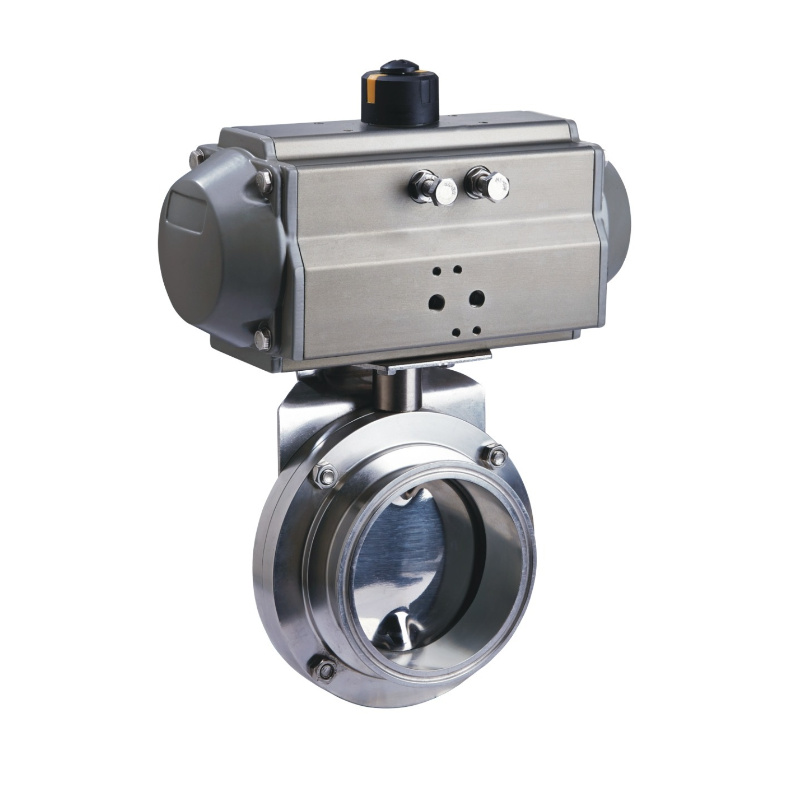
A sanitary butterfly valve is a compact quarter-turn valve designed for hygienic fluid handling and product-contact piping. It uses a circular disc that rotates around a shaft to start, stop, or isolate flow. Unlike a general industrial valve, a sanitary model is designed to reduce areas where product, cleaning fluid, or microorganisms can accumulate.
Sanitary butterfly valves are commonly used in food, beverage, dairy, cosmetics, biotechnology, and pharmaceutical processing. In these industries, the valve may come into direct contact with milk, juice, beer, syrup, liquid medicine, or other sensitive products. The wetted parts therefore need suitable materials, a cleanable internal design, and compatible elastomer seals.
A typical Sanitary Butterfly Valve may include the following features:
• 304 or 316L stainless steel wetted parts for corrosion resistance and product compatibility.
• A smooth, polished internal surface that limits product adhesion and supports effective cleaning.
• Crevice-reduced and self-draining geometry to minimize fluid retention.
• FDA-compliant or otherwise specified food-grade elastomers, depending on the application.
• Hygienic connections such as Tri-clamp, butt-weld, DIN, or SMS fittings.
• Manual, pneumatic, or electric actuation according to the process requirements.
Sanitary design does not simply mean that a valve is made from stainless steel. The complete flow path, seat design, surface finish, gasket, connection, and documentation must all match the hygiene requirements of the process. For high-purity applications, buyers may also specify electropolishing, surface roughness limits, orbital welding requirements, and USP Class VI seal materials.
A standard butterfly valve is a general-purpose flow-control or isolation valve used in utility, industrial, municipal, and non-hygienic piping systems. It also operates with a rotating disc, but its design priorities are usually pressure handling, durability, availability, line-size flexibility, and cost efficiency rather than maximum cleanability.
Standard butterfly valves are available in wafer, lug, and flanged configurations. Depending on the pressure, temperature, and medium, the body may be manufactured from ductile iron, carbon steel, stainless steel, or other alloys. The disc and shaft may use stainless steel, coated steel, or specialized materials, while the seat may be EPDM, Buna-N, PTFE, or a metal-seated construction.
These valves are often installed in cooling-water systems, HVAC piping, wastewater treatment, fire-protection systems, compressed-air lines, chemical utilities, and process-support services. They can be an economical and dependable solution when the medium does not require hygienic processing or frequent product-grade cleaning.
However, a standard valve is not automatically suitable for a product-contact line simply because it has a stainless steel body. Its internal cavities, shaft arrangement, surface finish, gasket profile, or elastomer certification may not meet the requirements of a food, beverage, or pharmaceutical process. The correct choice depends on the complete specification, not on the body material alone.

Sanitary and standard butterfly valves share the same basic operating principle, but they differ in the details that affect contamination control, maintenance, and lifecycle cost. The following table provides a practical comparison.
| Feature | Sanitary Butterfly Valve | Standard Butterfly Valve |
|---|---|---|
| Primary design goal | Hygienic processing, cleanability, and product protection | General flow isolation and economical operation |
| Typical body material | 304 or 316L stainless steel | Ductile iron, carbon steel, stainless steel, or other alloys |
| Internal geometry | Smooth, crevice-reduced, and designed to limit retention | May include cavities, pins, split shafts, or less hygienic transitions |
| Surface finish | Polished or electropolished; commonly specified by an Ra limit | Cast or machined finish suitable for general industrial service |
| Common connections | Tri-clamp, sanitary butt-weld, DIN, or SMS | Wafer, lug, and flanged connections |
| Seat materials | FDA-compliant EPDM, silicone, PTFE, or USP Class VI materials when required | EPDM, Buna-N, PTFE, metal seats, or other industrial materials |
| Cleaning compatibility | Designed for hygienic cleaning and may be specified for CIP or SIP service | Depends on the model; not normally optimized for product-grade CIP or SIP |
| Typical media | Milk, beverages, liquid food, pharmaceutical fluids, and cosmetics | Cooling water, air, wastewater, chemicals, and other utility media |
| Installation cost | Usually higher because of materials, finish, fittings, and certification | Usually lower and widely available in larger sizes |
| Main selection concern | Contamination prevention and regulatory compliance | Pressure, temperature, medium, line size, and operating cost |
The internal structure is one of the most important differences. Standard industrial designs may contain shaft interfaces, disc pins, or pockets that are acceptable for utility service but may retain product or rinse water. If the medium remains in these areas, it can create cleaning difficulties or increase the risk of microbial growth.
A sanitary design aims to keep the wetted path smooth and accessible to cleaning fluids. The disc, shaft, seat, and body are arranged to reduce unnecessary dead space. This does not eliminate the need for correct installation or validated cleaning procedures, but it makes the valve more suitable for hygienic processing.

Standard valves can use cost-effective materials because they are often installed in non-contact services. A Stainless Steel Sanitary Butterfly Valve generally uses 304 stainless steel for many food and beverage applications and 316L stainless steel where higher corrosion resistance or pharmaceutical compatibility is needed.
Surface finish is equally important. A polished surface with a specified roughness, such as Ra ≤ 0.8 μm for many sanitary applications, is easier to clean than a rough cast surface. Some high-purity processes require a tighter finish, but the exact requirement should come from the applicable process standard and customer specification.
A sanitary valve normally uses a seat and gasket system selected for product safety, temperature, and cleaning chemicals. The elastomer must resist swelling, hardening, cracking, and shedding during repeated service. Standard industrial seals may work well in water, air, or oil systems but may not carry the certifications required for food or pharmaceutical contact.
The connection also affects hygiene. Tri-clamp fittings and sanitary welds create cleaner transitions than many general-purpose flanged or lug arrangements. Nevertheless, gasket selection, welding quality, pipe alignment, and drainage must also be controlled.
The best way to select between these valve types is to divide the plant into product-contact lines and non-product-contact utility lines. A single facility may need both types, but they should not be treated as interchangeable.
Sanitary butterfly valves are suitable for product transfer, filling, blending, pasteurization, and hygienic tank connections. Milk, juice, beer, sauces, and liquid ingredients can be sensitive to contamination and flavor transfer. These systems commonly require polished stainless steel, hygienic fittings, food-grade seals, and repeatable cleaning performance.
A sanitary valve is especially important where the line is cleaned frequently using CIP chemicals or where the process includes hot water or steam. The valve specification should be matched to the cleaning temperature, chemical concentration, pressure, and cycle frequency.
Pharmaceutical and biotech lines often require a higher level of control. Product-contact equipment may need 316L stainless steel, low surface roughness, traceability, validated cleaning, and certified elastomers. Some systems also require SIP capability, orbital-welded piping, aseptic diaphragm valves, or special surface treatments.
A sanitary butterfly valve may be used for suitable isolation duties, but it should be selected only after confirming that its design and documentation meet the process requirements. For extremely high-purity or aseptic services, another hygienic valve design may be more appropriate.
Creams, lotions, gels, shampoos, and other personal-care products can leave residues on internal surfaces. A cleanable sanitary valve helps reduce residue retention and supports faster product changeovers. Seal compatibility is important because oils, fragrances, solvents, and cleaning agents can affect elastomer performance.
Standard butterfly valves are often the practical choice for cooling water, chilled-water loops, ventilation systems, sewage, fire-water systems, and general wastewater lines. These services typically prioritize large line-size availability, pressure capability, abrasion resistance, and lower purchase cost.
For corrosive or demanding industrial services, buyers may select High-performance butterfly valves or a valve with special disc and seat materials. Hygiene certification is normally not the primary selection factor unless the line also has a direct product-contact function.
Sanitary butterfly valves provide several advantages when installed in the right process environment.
A smooth, polished, low-retention flow path makes it easier for cleaning solutions to reach wetted surfaces. This supports CIP efficiency and shorter manual-cleaning requirements, although cleaning performance must still be confirmed through the plant’s validation procedure.
Food-grade or pharmaceutical-grade sealing materials help prevent contamination, taste transfer, and unwanted particles from entering the product. The correct seal also reduces the risk of premature failure caused by repeated exposure to heat and cleaning chemicals.
304 and 316L stainless steel provide strong resistance to moisture and many process chemicals. This is valuable in environments with frequent washdowns, acidic ingredients, alkaline cleaners, or high humidity.
When a valve is easier to drain and clean, operators can change between products with less risk of carryover. This can improve production flexibility, batch consistency, and equipment utilization.
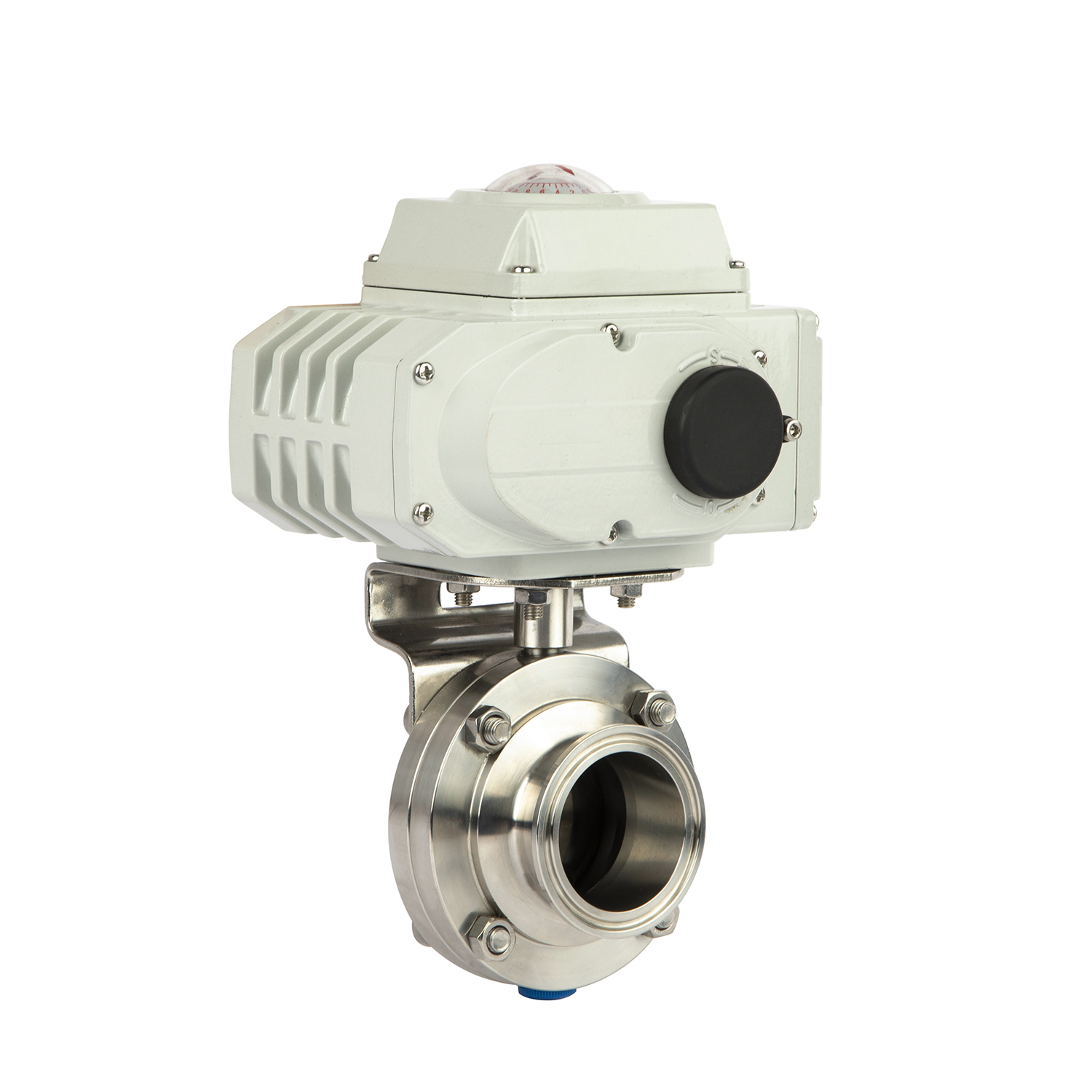
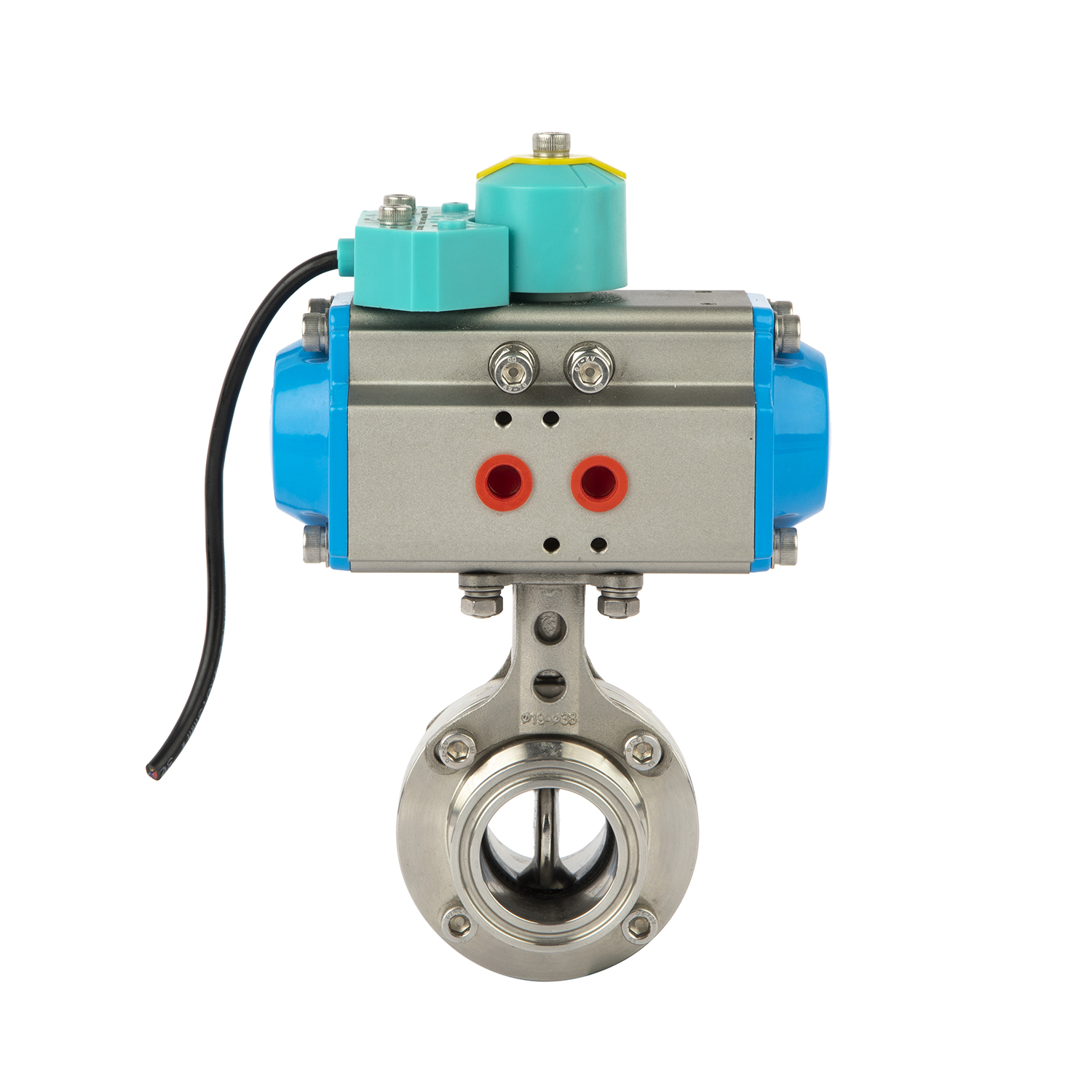
Sanitary butterfly valves can be equipped with pneumatic or electric actuators. A Pneumatic Sanitary Butterfly Valve is suitable for rapid, high-cycle operation in filling, bottling, and CIP manifolds. An Electric Sanitary Butterfly Valve may be preferred where compressed air is unavailable or where remote positioning and control feedback are important.
Before ordering, evaluate the complete operating and hygiene specification instead of selecting a valve based only on diameter or price.
Confirm whether the medium contacts the product:Product-contact lines normally need a sanitary design, while support and utility lines may use standard industrial valves.
Identify the medium and its properties:Record viscosity, solids content, abrasiveness, corrosiveness, temperature, pressure, and required flow rate.
Specify the body and disc material:Choose 304 or 316L stainless steel according to the product and cleaning environment. Confirm whether all wetted parts meet the requirement. A Stainless Steel Sanitary Butterfly Valve may be suitable when corrosion resistance and hygienic wetted surfaces are required.
Define the surface finish:State the required Ra value and whether mechanical polishing or electropolishing is needed.
Check seat and gasket compatibility:Compare the elastomer with the product, CIP chemicals, SIP temperature, and expected service life. Request FDA, USP Class VI, or other relevant documentation when required.
Select the connection type:Tri-clamp, sanitary weld, DIN, and SMS connections should match the existing pipework and hygienic design standard.
Choose manual or automatic actuation:Pneumatic actuators work well for fast, repeated cycles. Electric actuators are useful where electrical control, remote feedback, or proportional positioning is preferred. Compare a Pneumatic Sanitary Butterfly Valve with an Electric Sanitary Butterfly Valve according to the available utilities and control requirements.
Verify cleaning and drainage conditions:Confirm that the installed orientation, pipe slope, valve position, and cleaning flow support effective draining and cleaning.
Review documentation and testing:Request material certificates, pressure-test information, seal certificates, dimensional drawings, and maintenance instructions when the project requires traceability.
Choose a sanitary butterfly valve when the valve is installed in a product-contact line or when the process requires hygienic connections, polished wetted surfaces, certified seals, frequent CIP, or SIP-related performance. The higher initial cost can be justified by better contamination control, easier cleaning, reduced product loss, and improved compliance support.
Choose a standard butterfly valve or High-performance butterfly valve when the valve serves a non-contact utility or industrial line and the main requirements are reliable isolation, pressure and temperature performance, large-size availability, abrasion resistance, and cost control. Cooling water, HVAC, wastewater, fire-water, and plant-air systems are common examples.
The most cost-effective plant design is not necessarily one that uses sanitary valves everywhere. Instead, classify each pipeline according to its function and risk. Use hygienic equipment where it protects the product, and use appropriately rated industrial equipment where hygiene certification is unnecessary.
This approach avoids both under-specification that creates contamination risk and over-specification that increases capital cost without adding practical value.
Not necessarily. Stainless steel alone does not confirm hygienic suitability. Check the internal geometry, surface roughness, seat material, gasket certification, connection type, cleanability, and documentation before using any valve in a food product-contact line.
Many sanitary butterfly valves are designed for CIP service, but the exact model must be checked against the cleaning temperature, chemical concentration, pressure, flow velocity, and cycle frequency. CIP compatibility should be confirmed from the manufacturer’s technical data and the plant’s validation requirements.
They can be suitable within their rated pressure and temperature range, but hygienic butterfly valves are not automatically equivalent to high-performance industrial butterfly valves. Always compare the pressure rating, seat design, disc construction, and operating conditions before selecting a model.
A pneumatic actuator is usually preferred for fast, frequent cycling and fail-safe spring-return operation. An electric actuator may be more convenient where compressed air is unavailable or where remote control, position feedback, or slower precise movement is required. The best option depends on the plant’s utilities and control system.
Both are widely used stainless-steel grades. 316L contains molybdenum and generally provides better resistance to localized corrosion than 304, especially in more aggressive chemical or pharmaceutical environments. The correct grade depends on the product, cleaning chemicals, temperature, and applicable specifications.
Rough surfaces can retain product residue and make cleaning more difficult. A controlled polished finish reduces adhesion and supports repeatable cleaning. The required Ra value should be selected according to the industry, product, cleaning method, and validation standard.


