

Views: 0 Author: Site Editor Publish Time: 2026-10-13 Origin: Site


Choosing the right ball valve is essential for maintaining reliable flow control, safe operation, and efficient maintenance in industrial piping systems. Different valve designs provide different advantages depending on actuation method, pressure, media, installation environment, and maintenance requirements.
This guide explains the differences between Pneumatic Ball Valves, Electric Ball Valves, Flanged Ball Valves, and Three Piece Ball Valves, helping engineers and procurement teams understand where each design works best and how to choose the right valve for their system.
What Is a Ball Valve and How Does It Work?
Pneumatic Actuated Valve vs Electric Ball Valve
Pneumatic Ball Valve: Fast and Reliable Automation
Electric Ball Valve: Precise Motorized Control
Flanged Ball Valve vs Three Piece Ball Valve
Flanged Ball Valve: Heavy-Duty Industrial Connection
Three Piece Ball Valve: Easier Pipeline Maintenance
Ball Valve Type Comparison
How to Select the Right Ball Valve
Ball Valve Applications by Industry
Ball Valve Maintenance Tips
Choosing the Right Ball Valve for Your System
FAQ
Core Keywords: Ball Valve, Pneumatic Ball Valve, Pneumatic Actuated Valve, Electric Ball Valve, Flanged Ball Valve, Three Piece Ball Valve
Before comparing each design in detail, the following points summarize the main differences:
Pneumatic Ball Valves provide fast actuation and reliable high-cycle operation, making them suitable for automated manufacturing, chemical processing, packaging, and other applications with compressed-air infrastructure.
Electric Ball Valves provide controlled motorized operation without requiring compressed air, making them useful for HVAC systems, water treatment plants, automated pipelines, and remote installations.
Flanged Ball Valves provide strong, secure pipeline connections and are commonly selected for large-diameter, high-pressure, oil and gas, petrochemical, and power applications.
Three Piece Ball Valves are designed for easier in-line servicing, allowing the central valve body to be removed while the end connections remain installed.
The correct valve should be selected according to media compatibility, operating pressure, temperature, bore size, actuation requirements, pipeline connection, and maintenance conditions.
A ball valve is a quarter-turn valve that uses a spherical closure element with a bore through its center to control fluid flow.
When the bore of the ball is aligned with the pipeline, fluid can pass through the valve. When the ball rotates approximately 90 degrees, the solid portion of the sphere blocks the flow and isolates the pipeline.
A typical industrial ball valve consists of:
Valve body
Ball
Stem
Seats
Seals
End connections
Manual handle or actuator
One of the main reasons ball valves are widely used in industrial systems is their ability to provide rapid quarter-turn isolation and reliable shutoff.
Depending on the design, they may be operated manually or combined with pneumatic or electric actuators for automatic process control.
Full-port designs can also provide a relatively unrestricted flow path because the internal bore is approximately aligned with the pipeline diameter. This characteristic makes ball valves useful in applications where low flow resistance and efficient fluid movement are important.
Industrial automation often requires valves to be controlled from a PLC, control room, or automated production system.
Two common solutions are the Pneumatic Actuated Valve and the Electric Ball Valve.
The primary difference is the power source used to rotate the valve.
A pneumatic actuator converts compressed-air pressure into rotary motion, while an electric actuator uses a motor and gear mechanism.
Neither solution is automatically better for every application.
The correct choice depends on factors such as:
Required opening and closing speed
Available compressed-air supply
Electrical infrastructure
Required operating frequency
Fail-safe requirements
Hazardous-area conditions
Remote-control requirements
Flow modulation requirement
A Pneumatic Ball Valve combines a ball valve body with a pneumatic actuator.
Compressed air drives a rack-and-pinion or similar actuator mechanism, creating the rotary torque required to move the valve between open and closed positions.
One of the main advantages is fast actuation.
Pneumatic systems can operate very quickly, which makes them suitable for automated equipment requiring frequent opening and closing cycles.
For this reason, pneumatic ball valves are commonly used in:
Industrial automation
Water treatment systems
Chemical processing
Packaging machinery
Production lines
Process skids
Fluid dosing systems
Another important advantage is their suitability for high-cycle operation.
Because the actuator is powered by compressed air rather than relying entirely on an electric motor, pneumatic systems can be practical for applications where valves cycle repeatedly throughout the production process.
Spring-return actuators can also be configured so the valve moves toward a predetermined position if the air supply is interrupted.
This makes a Pneumatic Actuated Valve particularly useful where fail-open or fail-closed operation is part of the process design.
In environments involving combustible or potentially hazardous materials, engineers may also select appropriately specified pneumatic actuation because electrical components at the valve can be reduced or configured according to hazardous-area requirements.

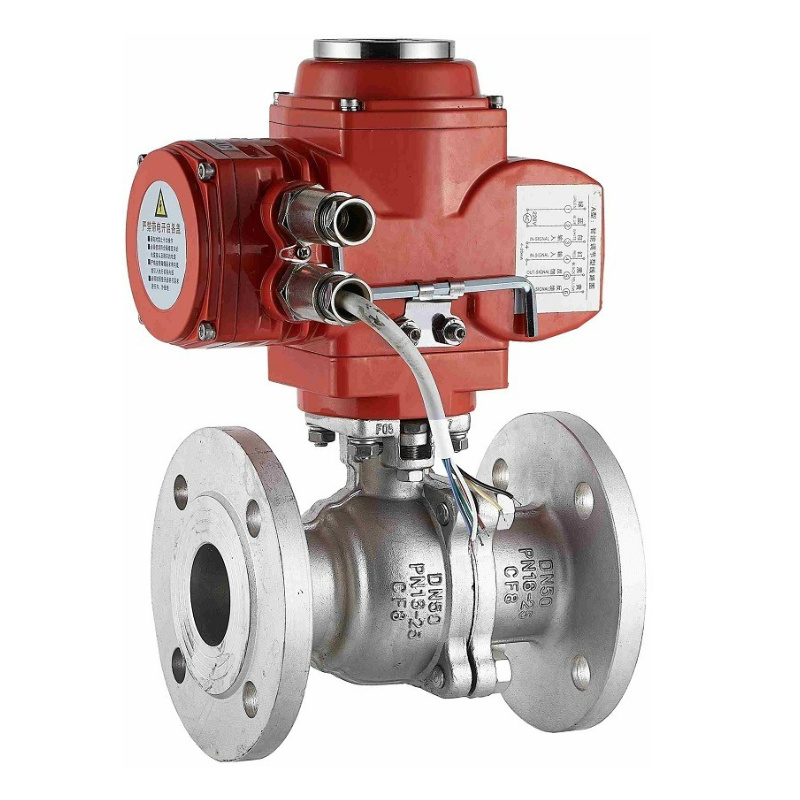
An Electric Ball Valve uses an electric motor and gear train to rotate the valve.
Compared with pneumatic actuation, electric actuators normally move more gradually. Depending on actuator design and size, a complete operating cycle may require several seconds.
This controlled movement can be useful in liquid pipelines because slower valve movement may help reduce sudden hydraulic shock or water hammer.
Electric actuators also provide an important infrastructure advantage:
They do not require a central compressed-air system.
This makes an electric ball valve especially useful for:
HVAC systems
Chilled-water systems
Water treatment systems
Automated pipelines
Building automation
Municipal water infrastructure
Remote pumping stations
Agricultural water systems
Electric actuators may also support position feedback, limit switches, or modulating control depending on the actuator configuration.
Where proportional control is required, suitable electric actuator systems can position the valve at intermediate angles rather than operating only in fully open or fully closed positions.
Therefore, an Electric Ball Valve is often a practical choice where electrical power is readily available but compressed air is not.
Actuation determines how a valve moves, but body construction determines how the valve connects to the pipeline and how easily it can be maintained.
Two important industrial designs are the Flanged Ball Valve and Three Piece Ball Valve.
A flanged design focuses primarily on providing a strong bolted pipeline connection, while a three-piece design focuses heavily on maintenance accessibility and modular construction.
A Flanged Ball Valve uses flange ends that are bolted to matching pipeline flanges.
These connections can be manufactured according to dimensional standards such as ANSI or DIN, depending on the valve specification.
Common industrial body materials can include carbon steel and stainless steel, selected according to system pressure, temperature, media, and corrosion requirements.
The major advantage of the flanged connection is high structural stability and secure installation.
Flanged ball valves are frequently used in:
Oil and gas pipelines
Petrochemical plants
Power plants
Chemical processing systems
Industrial water networks
Large-diameter process pipelines
High-pressure fluid systems
Bolted connections also simplify valve removal compared with permanently welded valve bodies.
During maintenance, technicians can isolate and depressurize the pipeline, remove the flange bolts, and remove the valve from the line.
This can be particularly useful for large industrial valves where pipeline integrity, secure mechanical connection, and maintainability are all important.
A Three Piece Ball Valve normally consists of a central body section positioned between two end connections.
Bolts hold the three sections together.
The principal advantage of this construction is maintenance accessibility.
When internal seats or seals require inspection or replacement, technicians may be able to remove or swing out the center section while leaving the two end connections attached to the pipeline.
This can reduce the amount of pipework that must be disturbed during routine servicing.
Three-piece ball valves are therefore widely suited to systems carrying:
Steam
Gas
Water
Chemical media
Process fluids
Food and beverage products
Industrial liquids
They are particularly attractive where valves must be inspected, cleaned, or serviced regularly.
For example, in certain food-processing or chemical systems, internal components may need periodic cleaning or replacement. A modular body design can help reduce the work required to access the valve internals.
For facilities where maintenance frequency is a major consideration, a Three Piece Ball Valve can significantly simplify valve servicing.
The following table summarizes the major differences between these four valve configurations.
| Ball Valve Type | Main Characteristic | Key Advantage | Typical Applications | Main Selection Consideration |
|---|---|---|---|---|
| Pneumatic Ball Valve | Compressed-air actuation | Fast operation and high cycle capability | Industrial automation, chemical processing, water treatment, packaging | Requires compressed-air infrastructure |
| Electric Ball Valve | Motorized actuation | Automated control without compressed air | HVAC, water systems, remote pipelines, building automation | Requires electrical power and suitable actuator control |
| Flanged Ball Valve | Bolted flange connection | Strong and secure pipeline connection | Oil & gas, petrochemical, power plants, large pipelines | Flange standard, pressure rating and installation space |
| Three Piece Ball Valve | Modular three-section body | Easier in-line servicing | Steam, gas, water, chemical media, food processing | Maintenance frequency and connection type |
Selecting a ball valve should involve more than simply matching the nominal pipe size.
Incorrect material, pressure rating, seat design, or actuator configuration can reduce valve life and increase maintenance requirements.
Several factors should be evaluated before finalizing a specification.
The valve body, seats, seals, and ball material must be compatible with the process media.
For example, corrosive chemicals may require stainless steel or another corrosion-resistant material, while ordinary water services may allow different material options.
Chemical compatibility should always be evaluated before selecting valve body and sealing materials.
Abrasive fluids may also require different seat or trim materials compared with clean water or gas.
Every valve has specified pressure and temperature limitations.
Operating temperature can affect allowable pressure, seat performance, seal life, and actuator requirements.
For high-temperature steam or aggressive process conditions, standard soft-seat configurations may not always be appropriate.
Always confirm the pressure-temperature rating of the complete valve assembly rather than selecting the valve based only on nominal pipe size.
A full bore or full-port ball valve has an internal opening approximately matching the inside diameter of the connecting pipeline.
This provides lower flow restriction and is often preferred where maintaining flow capacity is important.
A reduced-bore valve uses a smaller internal passage.
It can reduce size and material requirements but introduces greater flow restriction.
The correct choice depends on pressure-drop requirements, fluid characteristics, system economics, and process needs.
If the plant already has reliable compressed-air infrastructure and needs frequent, rapid valve cycling, a Pneumatic Ball Valve may be the logical solution.
If the installation is remote or only electrical power is available, an Electric Ball Valve may simplify system integration.
Selection should also consider:
Operating torque
Required cycle time
Fail-safe position
Control signal
Feedback requirements
Environmental protection
Hazardous-area classification
For large industrial pipelines, a Flanged Ball Valve offers a strong bolted connection and can simplify valve removal.
For systems that require frequent internal inspection or maintenance, a Three Piece Ball Valve may provide greater serviceability.
The valve body design should therefore reflect not only installation requirements but also the expected maintenance strategy.
Ball valves are used across a wide variety of industrial sectors because the basic quarter-turn design can be adapted to different pressure classes, materials, connection types, and automation systems.
Food, beverage, and pharmaceutical facilities often prioritize:
Cleanability
Corrosion resistance
Reliable sealing
Easy maintenance
Suitable materials
A Three Piece Ball Valve can be advantageous where frequent cleaning or internal servicing is required.
Pneumatic automation may also be used when valves must operate as part of automated filling, mixing, or processing equipment.
Chemical processing plants often require automated valves that can operate repeatedly as part of controlled production processes.
A Pneumatic Ball Valve is well suited to industrial automation where fast and repeatable valve movement is required.
Water treatment facilities may use either pneumatic or electric valves depending on available infrastructure.
Large treatment plants with central compressed-air systems may favor pneumatic actuation, while remote stations may find electric actuation easier to install.
HVAC installations frequently require automated water-flow control.
Electric actuators can integrate with building control systems and operate without an air compressor.
This makes the Electric Ball Valve suitable for chilled-water systems, heating-water systems, HVAC equipment, and automated building pipelines.
Remote water pipelines can benefit from the same principle because electrical control may be easier to provide than compressed air.
Industrial oil, gas, petrochemical, and power-generation systems often involve larger pipe diameters, elevated pressures, and demanding operating conditions.
For these environments, Flanged Ball Valves provide strong bolted connections and convenient valve removal during major maintenance.
Exact material, pressure class, seat design, fire-safe requirements, and other specifications should be determined according to the individual project.
Three-piece designs are particularly useful in industrial pipelines carrying steam, gas, water, chemical media, and other process fluids.
Where maintenance teams expect periodic seat replacement or internal inspection, the modular design can reduce the amount of surrounding piping that must be dismantled.
Even a correctly selected industrial ball valve requires proper inspection and maintenance.
A preventive maintenance program can help extend service life and reduce unexpected shutdowns.
Maintenance teams should periodically inspect the stem area for leakage.
Minor leakage around the stem may indicate that the packing requires adjustment or replacement.
However, excessive tightening should be avoided because it can increase operating torque and place additional load on the actuator.
Automated valves depend on correct actuator travel.
Limit switches and position feedback systems should be inspected periodically.
An actuator that does not rotate the ball completely into the required position may reduce shutoff performance or create unwanted flow restriction.
Pneumatic systems should also be checked for air leakage and adequate supply pressure.
Electric actuators should be inspected according to their electrical and mechanical maintenance requirements.
If a valve leaks internally while in the closed position, the seats or sealing surfaces may be worn or damaged.
Contaminants, abrasive solids, or repeated cycling can contribute to seat wear.
A Three Piece Ball Valve can simplify internal inspection because the center body can be accessed without completely removing both pipeline connections.
For larger flanged valves, repair kits or component replacement may be more economical than replacing the complete valve, depending on valve condition and manufacturer recommendations.
Selecting the correct Ball Valve requires matching the valve design to the actual operating conditions rather than choosing only by size or price.
A Pneumatic Ball Valve is a strong option for fast, high-cycle industrial automation where compressed air is available. An Electric Ball Valve is well suited to HVAC, water systems, remote installations, and automated pipelines where electrical control is preferred.
For demanding industrial pipelines, a Flanged Ball Valve provides a secure bolted connection, while a Three Piece Ball Valve provides easier access for maintenance and internal servicing.
By evaluating media, pressure, temperature, actuator type, connection method, maintenance frequency, and control requirements, engineers and procurement teams can select a ball valve that provides reliable long-term operation.
Explore China-Konte's range of industrial ball valves and automated flow-control solutions to identify the configuration that best matches your pipeline and process requirements.
Neither design is universally better.
A Pneumatic Ball Valve is generally preferred for rapid cycling, high-frequency operation, and installations with existing compressed-air infrastructure.
An electric ball valve is often more practical where electrical power is readily available but compressed air is not.
The correct solution depends on operating speed, control requirements, fail-safe requirements, installation conditions, and available utilities.
Pneumatic actuation generally provides faster valve movement because compressed air can rapidly drive the actuator through its operating stroke.
Electric actuators typically operate more gradually because a motor and gear train rotate the valve.
Therefore, Pneumatic Ball Valves are commonly selected where rapid opening and closing is important.
Standard ball valves are primarily used for on/off isolation.
Operating a standard ball valve in a partially open position for extended periods can expose the seats and internal components to concentrated flow velocity and wear.
For applications requiring regular flow modulation, a purpose-designed control valve or V-Port Ball Valve may be more appropriate.
The primary advantage is serviceability.
A Three Piece Ball Valve allows the center body section to be accessed or removed while the end connections can remain attached to the pipeline.
This can simplify seat replacement, cleaning, inspection, and other maintenance activities.
Flanged valves are commonly preferred for larger-diameter and heavier industrial piping systems because bolted flange connections provide strong mechanical installation and make valve removal relatively straightforward.
Threaded connections can still be suitable for smaller pipelines and less demanding applications.
The correct connection depends on pipe size, pressure, media, maintenance requirements, and applicable piping standards.
A Full Bore Ball Valve has an internal passage approximately equal to the inside diameter of the connecting pipe, providing lower flow restriction.
A reduced-bore valve has a smaller internal passage.
Reduced-bore designs can reduce valve size and material requirements but normally create greater pressure loss.
The repair method depends on where the leakage occurs.
Leakage around the stem may be related to stem packing, while internal leakage in the closed position can indicate seat or sealing-surface damage.
For a Three Piece Ball Valve, the center body can often be accessed for seat inspection or replacement.
For other designs, the valve may need to be removed from the pipeline or replaced depending on its construction, size, condition, and maintenance economics.


